Monday, 7 November 2016

HEATHROW EXPANSION: COUNTY TRUSTS WARN OF IMPACT ON WILDLIFE

                                                                    
Wildlife at risk - London's Heathrow Airport

THE UK's county wildlife trusts have waded into the row over the decision to approve an additional runway at London's Heathrow Airport.

This is by contrast with organisations such as the RSPB ("Giving Nature a Home") and Natural England which have so far been reticent to speak out. 

In a joint statement, the trusts say: "Vast effort must go into mitigating any airport expansion through investment in soil restoration, peatlands, energy efficiency and renewable energy.
 
"Given the very great value of a wildlife-rich, healthy natural environment, and the enormous pressure it faces, not least in the South east of England, any airport development must minimise its direct impacts on wildlife and  habitat.


"We need  thorough, evidence-based assessments of these potential impacts as early as possible, so that they can be annulled where possible or at least  minimised with effective mitigation."

The statement  continues: "Given what we know about habitat damage and loss of wildlife, it is  unacceptable for any major development to be approved unless it can be shown that it will have a net-positive impact on wildlife, wild places and the wider natural environment.

"If the Heathrow expansion goes ahead, development on this scale (which will include rerouting of the M25 motorway), will require a massive effort to ensure that important wildlife sites in the surrounding areas are retained and designed into plans from the outset. 

"Where wildlife habitats are lost, new habitat must be created as near as possible to the site and on a much greater scale than the area lost."

The trusts further note  that  access to high quality, wildlife-rich natural green space makes a very important contribution to public health, wellbeing and  the quality of life of millions of people in the South-east

They say there needs to be  "a thriving network of high quality wildlife-rich places possessed of maximum peace and tranquillity". 

* To end on a positive note, the American corporate giant United Technologies, is making significant strides, through its Pratt & Whitney division, to devise jet engines that cut fuel-burn and carbon emissions by as much as 16 per cent, thereby slashing the release of the tiny particulates that are though to cause lung and heart disease. While aviation generates only two per cent  of global carbon emissions, the impact is great because they are released in the upper atmosphere. The new engines should also be much less noisy than those currently in use.

* Photo of Heathrow Airport:  Konstantin Von Wedelstaedt via Wikimedia Commons

Sunday, 6 November 2016

PLEASURE DRONE'S SALTMARSH PURSUIT OF BARN OWL

A DRONE enthusiast has posted on YouTube this video of a  barn owl  over saltmarsh.

https://www.youtube.com/watch?v=oaYsyZZFxbQ

The  owl does not seem to be in any distress, nor is there any indication of disturbance to waders, wildfowl or other birds.

But is drone-flying to be encouraged - particularly over a site of wildlife interest?

As the use of drones becomes more prevalent, it is a subject about which more is likely to be heard.


Meanwhile,  the RSPB - which campaigned against plans for a 300-turbine windfarm off the Yorkshire Coast has now accepted funding  from Dong Energy - the Danish company that plans to build and operate  the windfarm - for a drone initiative.

Dong has put out a media statement which says: " A high specification drone has been used in a successful trial to count cliff-nesting seabirds on the Yorkshire coast thanks to funding from Dong.

"The trial took place at Bempton Cliffs, part of an internationally important site which attracts over 250,000 birds annually, providing a breeding ground for many of them.

A drone, provided by environmental consultancy NIRAS, was used to see if the technology was suitable to carry out future surveys of cliff-nesting seabirds. 

"The survey data will be used by the RSPB, and it will also help as DONG Energy makes plans for the development of offshore wind farms off the Yorkshire coast, such as Hornsea Project Three."

The statement continues: "Previous seabird counts have been undertaken visually from a boat and were so highly weather dependent that it has limited the number of years in which complete colony counts have been possible."

According to Dong's UK environment specialist, Allen Risby, the success of the trial was dependent on the drone being able to get close enough to the colony "to provide imagery of a resolution sufficient to distinguish between the different bird species while ensuring ensuring that the breeding seabirds were not disturbed".

He added: "The birds showed minimal interest in the drone which produced photos detailed enough to distinguish between guillemots and razorbills, two species of auk that can look similar when observed from a distance."
 

Friday, 4 November 2016

ARE FIREWORKS A THREAT TO BIRDS?

Starlings - spooked by rockets and bangers?
                                       
There is "little evidence" to suggest that fireworks harm wild birds or affect their conservation status.

That is the official position of the RSPB which states: "Information suggests that the effect of firework displays on birds is little different from that of a thunderstorm.

"However, we  continue to monitor the situation  to ensure the best course of action for wild bird conservation."

The charity spokesperson continues: "Setting off fireworks close to nesting and roosting birds can cause disturbance.

"To minimise any adverse impact of fireworks on birds, organisers of firework displays should avoid launching rockets near to sensitive wildlife areas such as nature reserves and roosting sites."

It adds: "If a summer firework display were to  set up close to a nesting site of a Schedule 1 species, any disturbance resulting in nest failure would be classed as reckless disturbance and be an offence under the Wildlife and Countryside Act."

The organisation, PETA (people for the Ethical Treatmentof Animals) has a different view.

Taking a perspective on the traditional July 4 Independence Day celebrations, commentator Michelle Sherrow says: " Fireworks have been  blamed for the deaths of 5,000 birds in Arkansas.

"The professional-grade explosives scared red-winged blackbirds and European starlings out of their nests and sent them into panicked flight. 


                   Male red-winged blackbird - nesting hens went into panic mode                                      
                                       
"The night-blind birds crashed into houses, signs, and other obstacles, causing blunt-force trauma and death.

"Besides being frightening, fireworks produce plumes of smoke that are harmful to animals’  respiratory systems and pollute standing water.

"The California Coastal Commission banned the city of Gualala’s fireworks display after a 2006 show caused nesting seabirds to flee their nests and abandon their chicks."

Ms Sherrow continues: "Fireworks were also blamed for the deaths of about 50 birds found dead on a street in Sweden.

"You can help birds and other animals by asking officials in your town to ban fireworks and switch to laser light shows which provide all the awe of fireworks displays but are more affordable and kinder to animals, birds and the environment."

Staying in the US, the Audobon Society published an article in which blogger Catherine Griffin referred to Dutch scientists using radar to track bird disturbances in grassland and wetland areas during firework displays.

She wrote: "They found that birds in those areas had a tendency to take flight en masse during displays - a non-fatal move in open areas but more deadly in urban locations."
 
Her conclusion: "If you want to see  fireworks and protect birds, too, the best thing  is to attend a commercial display rather than setting off your own pyrotechnic devices.

"Commercial fireworks are concentrated in one location rather than in several locations at once which is what often happens in neighborhoods.

"This allows birds to take off and land again in a “safer” location rather than continuing to flee noises coming at them from all directions.

"In addition, professional displays often take into account the natural environment and any impacts they might have." 


Photo credits:
* Eurasian starling: Tim Felce (Airwolfhound) via Wikimedia Commons
* Red-winged blackbird: Walter  Siegmund via Wikimedia Commons


LINCOLNSHIRE'S INLAND PURPLE SANDPIPER


Purple sandpipers are more often seen pecking about in seaweed on rocky beaches than inland, but this bird has spent most of the week providing excellent  close-up views at Covenham Reservoir, near Louth in Lincolnshire.


Mainly dark grey above and whitish below, the species'  beak is slightly down-curved and the  short bright orange legs are distinctive.

     
According to the British Trust for Ornithology, diverse populations of this sandpiper winter in Britain and Ireland

Those in the north and west originate from breeding grounds on  tundra in Arctic islands, in Canada and in coastal areas of Greenland

Those found on the eastern side of the  UK are more likely to come have come from North-eastern Europe, including Scandinavia


The species is thought to be in decline but it is probably overlooked because it is well camouflaged when feeding on seaweed covered rocks, not infrequently  in the company of turnstones


Thursday, 3 November 2016

CHEMICAL 'SOAKING' FOR LINCOLNSHIRE NATURE RESERVE FRINGE


It looks colourful, extravagantly so, but . . .


By allowing an alien powder to be scattered over part of Cleethorpes coastal nature reserve in advance of a late-summer foreshore  fun-run,  North East Lincolnshire Council scarcely enhanced its reputation as a custodian of wildlife.


Whatever the substance (probably dyed cornflour), its distribution  will have done no  favour to any butterflies, bees, ladybirds, grasshoppers or other  insects unlucky enough to have been within the deposit zone. 


If an individual or business offloaded a mystery chemical over part of the nature reserve, it would probably face prosecution, but, because of the involvement of a partner organisation of the council (Lincs Inspire), a blind eye was probably turned. 

No one likes a spoilsport (or a killjoy), and the luminous substance doubtless added to the gaiety of the occasion, but, if the event is to be repeated in future, here's hoping the integrity of the nature reserve will be respected.


FOCUS ON WELSH BIRDING SCENE


BBC TV broadcaster Iolo Williams (pictured) will provide the introduction to  the annual Welsh Ornithological Society conference to be held this Saturday (November 5) at Llandovery on the edge of the Brecon Beacons.

The all-day event will include presentations on:


  • Birds and Climate Change (Dr Rob Thomas);
  • Whinchats (Steve Smith);
  • Combining Field Techniques -Traditional and Novel (Emily Scragg);
  • Curlews, Goldies, Twite and Whitefronts (Jon Cryer);
  • How Mimicry Can Influence Breeding Success (Gavin Vella);
  • 25 Years of the Welsh Chough Project (Tony Cross and Adrienne Stratford).

More details on the BTO website.

Tuesday, 1 November 2016

IMPORTANT SURVEY WILL ASSESS IMPACT (IF ANY) OF OFFSHORE WINDFARMS ON LESSER BLACK-BACKED GULLS

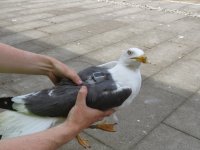
Lesser Black-backed Gull by Gary Clewley/BTO
Tags could provide vital data
                                              
VALUABLE information about the threat, if any, posed by offshore windfarms to lesser black-backed gulls could emerge from a forthcoming project.

The BTO and Danish company Dong Energy have teamed up to assess how lesser black-backed gulls reacts to turbines located off the Cumbria coast.
 
Over two years, state-of-the-art GPS tags will be tracking  the movements of gulls both from a colony at Cumbria Wildlife Trust’s South Walney Nature Reserve and from rooftops in Barrow-in-Furness.

The tags have been designed to sit between a bird’s wings like a backpack and will allow researchers to understand many different aspects of these birds’ lives around windfarms, including, crucially, whether gulls are at risk of death through collision with turbine blades.

Says the BTO's Emily Scragg: "The tagging will provide an unprecedented opportunity to discover how seabirds respond to the construction of an offshore wind farm as well as to understand further their movements through the year.”


 “I can’t wait to see the results!”

Equally enthusiastic is  Dong Energy's lead environmental and consent specialist, Allen Risby, who says:  “We are keen to learn more about how these gulls behave around offshore windfarms as they fly above, below or between the individual  turbines. 

“They might  provide opportunities for the gulls, too.”

The study is being jointly funded by the Walney Extension and Burbo Bank Extension projects, two of the offshore wind farms that Dong is currently constructing off the northwest coast.

Tagging was undertaken this year during the gulls’ summer breeding season, and the work  has already shown some differences in the use of offshore areas by birds from South Walney and Barrow.

But the really important data will not emerge until the construction phase of the windfarms through to when the turbine blades start turning.