Monday, 12 May 2025

Rare opportunity beckons to bid for seven-volume masterpiece by forgotten Victorian artist Henry Meyer


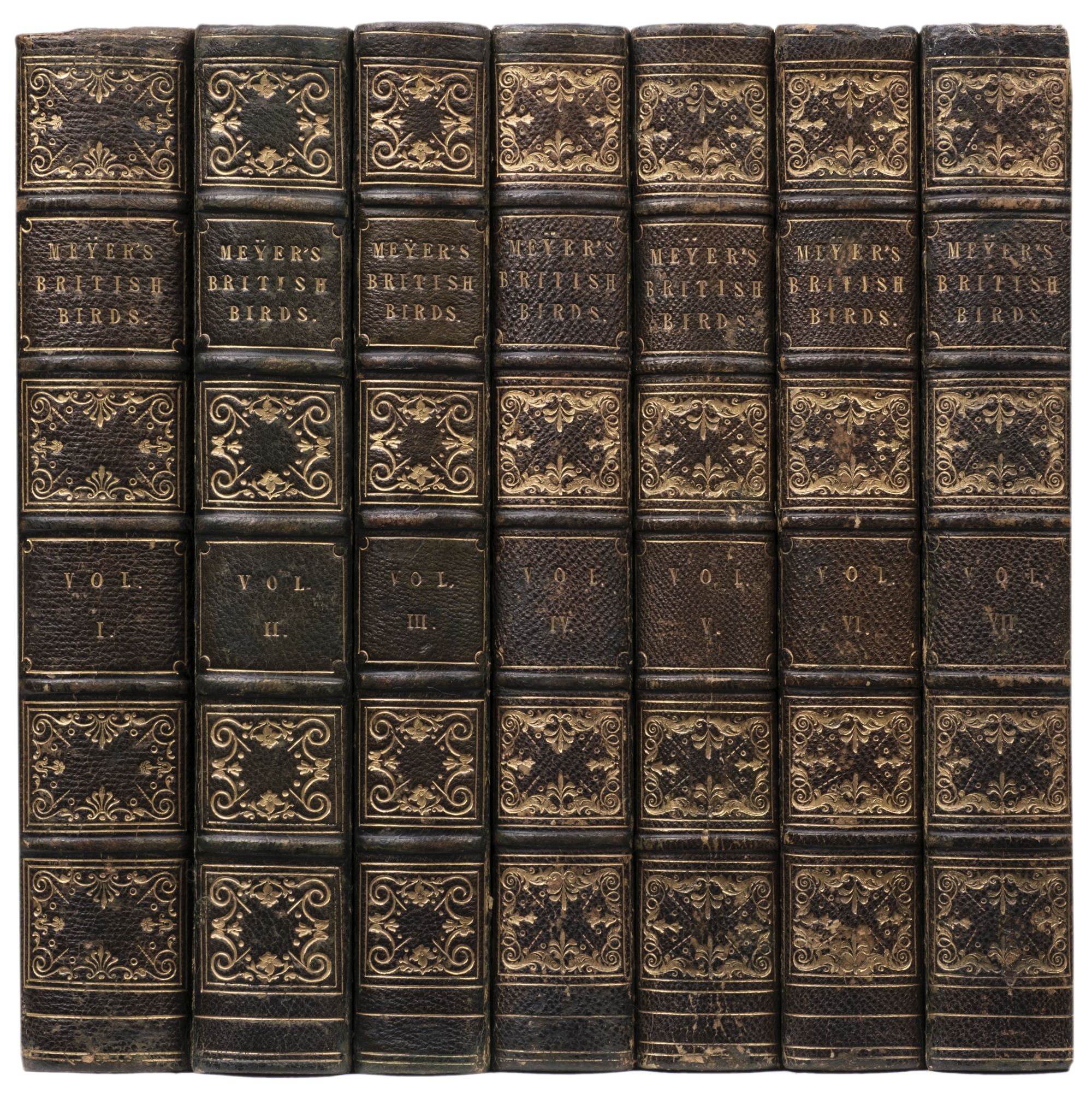
The ornithological world seems largely to have forgotten artist Henry Leonard Meyer (1797-1865) but he made a notable contribution with his Coloured Illustrations of British Birds and Their Eggs which was published in seven volumes between 1842 and 1850. The full set of volumes - unfortunately with two of the hand-coloured lithographs detached - is due to go under the hammer (Lot 127) at a sale to be conducted by auctioneers Dominic Winter at their saleroom in Cirencester on Wednesday May 14. The guide price is between £400 and £600. Pictured below are some of the illustrations which are understood to be in Volume 1.


Dipper


Red-backed Shrike


Pied Flycatcher


Great Grey Shrike


Sunday, 11 May 2025

Will the Magpie be returned to the crest of Newcastle United FC? Fans will be asked to decide


The crest as it is today - not the hooves on the seahorses!


IS it time for Newcastle United FC to restore the Magpie to the club's crest?

Because of their black and white strip, the Premier League side have always been nicknamed The Magpies.

In the past, the bird has featured at least twice in their emblem.

But in recent years, it has been ditched in favour of two seahorses  which are thought better to reflect the Tyneside port's maritime heritage.

However, this crest is due to be changed subject to consultation with members and season ticket holders who will have the final say.

Says the club: "As our club grows on the global stage, the symbol that represents us needs to be able to keep pace. 

"It needs to show up clearly and confidently across everything - from kits to screens to merchandise.

"So we've been asking ourselves: how well does our current crest represent the club today? And how well will it serve us tomorrow?

"It's time to update our crest 

"This isn't a decision we take lightly. We love our crest. It's iconic and has stood us through unforgettable triumphs and testing times. 

"But it was created in a different era. Its intricate design doesn't always translate well in today's digital world. And it's difficult to reproduce it clearly and consistently.

"As football and the world changes, so too must the symbol that unites us.

"This isn't about walking away from our past. It's about carrying it forward with pride. 

"The crest is part of our story. It's on our shirts and inked in our skin.

"It deserves thoughtful evolution - shaped by the voices of the people who love it." 


Above and below - the Magpie used to feature on the crest


Saturday, 10 May 2025

Grimsby Swift enthusiasts' in plea for help as they strive to revive fortunes of under-threat bird


Time was when Swifts nested in the church tower but those days are thought have long gone

AN appeal has been sounded for any information  about the whereabouts of Swifts in Grimsby, Cleethorpes, Immingham and other towns and villages in North-east Lincolnshire.

As in other parts of Britain, there has been a huge decline over the past couple of decades - and they are no longer thought to nest in, for example, Grimsby Minster, also known as St James' Church.

Any data will be collated by the Grimsby Area Swift Project, a group set up four years ago to monitor breeding sites and to seek to persuade housebuilders to incorporate special Swift nesting bricks in their developments.

Says co-ordinator Joy Croot: "The alarming decline of this iconic summer visitor is mainly due to the loss of nesting sites. 

"Swifts are reliant on dark crevices high up in buildings to make their nests, and will return to exactly the same spot each year. 

"The trend for restoration, renovation and PVC soffits has meant that many Swifts have lost the homes that they’ve used for many years and can no longer find a suitable replacement. 

"Swift boxes, and particularly integral Swift bricks, make an ideal substitute nest for this red-listed species. 

"Other birds though, such as Great Tits, Blue Tits, House Sparrows, Starlings and House Martins will also use them."

She continues: "GASP lobbies Lincolnshire local authorities' planning departments to recommend the incorporation of Swift bricks into all new builds

"We talk to developers and builders; we give presentations to various groups about Swifts; we install Swift boxes at suitable sites; we have strong links to Swift groups around the country.

"But we need input from the public

"We would like to hear from anyone in North East Lincolnshire who knows of:

* A Swift brick being used for nesting by Swifts (they are here between April/May to August/September

* A Swift brick being used by another bird species for roosting or nesting

"We would also welcome sightings of  ‘screaming parties’ of Swifts and from anyone who is  a in a position to be able to influence builders or developers."

Anyone who can help should contact Joy or Martin Francis at: 

grimgaspers@gmail.com


Friday, 9 May 2025

Three of the best - Wryneck, Ring Ouzel and Cuckoo make surprise stop-off in Lincolnshire horse paddock


It is always a thrill to see a Wryneck in Britain, especially in spring when these passage migrants tend to be much scarcer than in late summer and early autumn. The bird above was feeding in a horse paddock at Tetney Lock, in Lincolnshire, mid-morning today. Just a few metres away, a female Ring Ouzel was also present while, on an overhead wire, a calling Cuckoo completed the trio of summer migrants.  


Thursday, 8 May 2025

Woodpecker studies by Newcastle-upon-Tyne artist James Alder likely to attract interest at Yorkshire auction


Two 1967 paintings by Newcastle-upon-Tyne artist and sculptor James Alder (1920-2007) are expected to fetch between £250 and £400 when they go under the hammer at a sale to be conducted by Tennants at their auction house in Leyburn on Saturday of next week (May 17). A former president of the Natural History Society of Northumbria, Alder probably  reached the pinnacle of his career when he was commissioned to illustrate The Birds and Flowers of the Castle of Mey for the late  Queen Elizabeth the Queen Mother and Birds of Balmoral for the late Queen Elizabeth II. 


Wednesday, 7 May 2025

Relief at RSPB - especially at its Yorkshire seabird reserve - as wind energy giant pulls plug on 180-turbine project


A DECISION by renewables energy giant Ørsted not to proceed with a new windfarm off the Yorkshire will prompt a few sighs of relief at the RSPB - not least at its seabirds reserve in Bempton.

Although the society is generally supportive of wind energy, it changes tack if turbines threaten to comprise its reserves, especially those that are huge generators of visitor revenue.

The RSPB had been particularly worried that the 180 turbines at the proposed Hornsea 4 development would deter birds from returning to their cliffside breeding sites.

The Bempton Big Six are: Fulmar, Gannet, Guillemot, Kittiwake, Puffin and Razorbill. 

Ørsted announced earlier today that it would not be proceeding with Hornsea 4, attributing the decision to ever-increasing supply chain costs, high interest rates and construction risks.

Said its chief executive Rasmus Errboe: "We remain fully committed to being an important partner to the UK government to help them achieve their ambitious target for offshore wind build-out and appreciate the work they’ve done to deliver a clear framework to support offshore wind. 

"However, our capital allocation is based on a strict and value-focused approach, and after careful consideration, we’ve decided to discontinue the development of the Hornsea 4 project in its current form."

He continued: "We have been maturing the project over the past nine months and have been working relentlessly with stakeholders and suppliers to manage the different project risks for a project of this scale. 

"Throughout the development phase, we have been diligent in our approach to capital commitment to our suppliers, and our committed capital is well below our threshold. 

"The adverse macroeconomic developments, continued supply chain challenges and increased execution, market and operational risks have eroded the value creation."

It was back in July 2023 that the then Environment Secretary, Grant Shapps, approved Hornsea 4.

In recognition that there would probably be an adverse impact on seabirds, the energy company offered to build a nesting platform for Kittiwakes off Whitby.

Ørsted will take a huge financial hit - upwards of £500-million according to some estimates - as a result of today's decision.  

The pull-out will also hit hopes of more jobs being created in Grimsby which is service hub for maintenance at its turbines within the Hornsea 1 and 2 windfarms which are already operational and Hornsea 3 which is under construction.


Fulmars - its breeding numbers are on a downward trend at RSPB Bempton


Sunday, 4 May 2025

Global Birdfair, July 11-13, 2025: The full list of Sunday's speakers - including Tim Mackrill


Tim Mackrill, author of The Osprey, will be discussing this species with Roy Dennis and Tim Appleton at 3pm - appropriately enough on the event's  Osprey stage


Osprey Lecture Theatre 

1000:  To be Confirmed 

1100: Wildlife Gardeners’ Question Time 

1200: Nigel Marven: A Career with Dinosaurs and other Remarkable Reptiles

1300: Nick Baker  

1400: Simon King: Tales from the Bush and Beyond 

1500: Roy Dennis, Tim Mackrill and Tim Appleton: Ospreys and other conservation success stories

-

Avocet Lecture Stage  

1000: Will Fox:  My life with Leopards 

1030: Dan Brown: Spectacular Shetland Wildlife 

1100: Susannah Kerr:  Wildlife of the Scottish Highlands  

1130: Martin Kelsey: Extremadura - birding off the beaten track 

1200: Leonardo de Moura Persi: Brazil - The country of birds  

1230:  Daniel Roman 

1300: Dr Sophie-Lee Williams: Restoring White-tailed Eagles to South-east Wales and Severn Estuary 

1330: Tim Jones: Migfest - the Spurn Migration Festival

1400: Rebecca Nason; Shetland Seabird Tours - The Noss Boat 

1430: Claudien Nsabagasani: Birding and Safaris Tours in East Africa 

1500: Dan Brown:  Islay & Jura in Autumn: The Eagle Islands 

1530: Balázs Szigeti:  Eye to Eye with Snow Leopards 

-

Curlew Lecture Stage 

1000: Naomi Johns: Understanding Falco tinnunculus - the European Kestrel 

1030: James Stevens: The Inner and Outer Hebrides 

1100 : Craig Fellowes: Fighting wildlife crime

1130: Martin Beaton: The Falkland Islands 

1200: Helen Bryon: Brazil - including the  Cerrado, the Amazon and the Pantanal 

1230: Simon Barnes: Lost in the Bush - a tribute to a pioneer of Zambian birding, the late Bob Stjernstedt 

1300: Harry Munt: How an encounter with a Kestrel and a chalkpit changed my life 

1330: Chandika Jayaratne: Sri Lanka's wildlife and how tourism is driving conservation 

1400: Richard Baines: The Rarity Garden - The Great White Cape of Flamborough

1430: Bret Charman: Australia - Wildlife Down Under 

1500: Belen Rodriquez: Ecotourist Reserve of Green Spain 

1530: Steven Stansfield: Bardsey - the island of 20,000 saints and shearwaters 

-

Plover Lecture Stage 

0930 To be Confirmed 

1000 To be Confirmed 

1030: Victoria Woolley:  Art For Wildlife - How art can reconnect us with nature and help to raise awareness of projects by bringing people together. 

1100: Rajan Jolly: Tigers of Central India 

1130: Harriet Mead and Nick Acheson:  Wild Heath, Wild Art 

1200: Łukasz Mazurek: Bison, birds and dead wood - birdwatching in Białowieża Forest 

1230: Oliver Smart: The Gambia, an introduction to birding in Africa 

1300: Jon Mason: Night at the Reserve: Wild Stays at Welney 

1330: Alberto Bosque Coello: Castilla y León - a great destination for natural life lovers. 

1400: Tony Williams:A look at wildlife in four French gardens, covering France from north to south with main species of interest 

1430: Richard Parsons: Bellavista and North-western Ecuador 

1500: Paul Stanbury: Tanzania’s Wildlife Highlights 

1530: To be Confirmed 

* See previous two posts for speakers on Friday and Saturday.