Monday, 9 September 2024

Bygone birding: 'shorely' a very unromantic habitat to discover recently-arrived nightingales


This extract is from Our Summer Migrants by J.E. Harting, published in 1875: 

The Nightingale has been pictured by poets and naturalists in various romantic situations, but perhaps never before in so unromantic a spot as  "under a bathing-machine"! 

Yet Mr. Monk states that on the 13th of April, 1872, there were  Nightingales "on the beach under the bathing-machines along the whole length of the shore at Brighton." 

The explanation which suggests itself is that the birds had just arrived, and they had sought the first place which offered a woody shelter.

It is true that it is a shady place although of a very different kind to that which the birds would have been accustomed.


* Cartoon of 'mermaids' and bathing huts in Brighton via Wikimedia Commons                                             

Sunday, 8 September 2024

Charity Commission satisfied RSPB has changed its ways following social media abuse of Cabinet ministers


The RSPB's HQ - The Lodge in Sandy, Bedfordshire. Chief executive Beccy Speight, who works from her home in Nottinghamshire, was not made aware un advance  of the abusive social message posted by a colleague, so she quickly apologised on BBC Radio 4  

THE Charity Commission says it has now closed its probe into the RSPB over the charity's   controversial  party political activity on social media.

It states: "Last year, we opened a regulatory compliance case into the RSPB after a six-part thread was posted on X (formerly Twitter) stating that named former ministers were ‘Liars’. 

"Charities should not be afraid to use their voice passionately to campaign for causes they represent, but they should always be acting in its best interests and must not be party political.

"It was important we took steps to ensure this did not happen again, particularly ahead of a General Election."

The statement continues: "We found that the tone and nature of RSPB’s post was inappropriate and had not been signed off at the appropriate level within the charity. 

"More could have been done to ensure internal policies and procedures were followed. 

"However, in July 2024,  we closed our case noting that the charity’s trustees had taken sufficient remedial action. 

"This included the charity issuing an immediate public apology, carrying out an independent investigation and implementing changes to strengthen internal policies with use of Commission guidance.

"We received no concerns about the RSPB during the General Election period."

The Commission  has also taken the opportunity to outline its approach to charities’ use of social media in campaigning.

It says: "Charities may use social media as part of their campaigning and political activity on issues that relate to their specific charitable purposes. 

"Social media can be an effective way to reach current and prospective supporters.

"However, the same rules apply online - charities cannot be party political and should take care to consider any risks of their social media campaigning activity that could negatively impact their charity’s reputation.

"This includes personal attacks or inflammatory rhetoric. 

"The Commission expects charities to engage in public discourse in a way that promotes respect, tolerance and consideration for others.

"All charities should take care to ensure they are aware of and follow our social media, campaigning, and political activity guidance."

It is believed that the individual responsible for posting the online insult has now left the RSPB to work for another charity.

Saturday, 7 September 2024

Has 'self-isolating behaviour' of Puffins been key to their 2024 population increase in Farne Islands?


Puffins - bouncing back after disaster of bird flu


DESPITE declines elsewhere in Britain and other parts of Europe, Puffins are not just holding their own but increasing in the Farne Islands, off the coast of Northumberland.

The first count since 2019 has  delighted the National Trust which monitors the seabirds that breed on the islands.

The number of pairs this year is reliably estimated to have been 50,000 compared with just under 44,000 five years ago - up 15 per cent.

Says NT ranger for the islands, Sophia Jackson: "We feared the worse after we sadly collected 938 dead puffins - victims of bird flu - in 2022 and 2023.

"It seems they have weathered the storm thanks to self-isolating behaviour."

To conduct the count, Sophia and colleagues  monitored the birds by observing nesting burrows for signs of activity. 

If they were unsure if a burrow was occupied, the rangers donned wipe-clean, arm-length gloves, then put an  arm down the burrow to  feel for any occupants.

Continues Sophia: "We think another reason for Puffins having done well this year is down to the weather.

"During the breeding season, we had regular  periods of rain but none of the  storms that might have hampered the birds'  ability to fish for sandeels, their preferred food."

An interesting finding from this year’s observations was the variance in  numbers across the islands between this year and the last count.

Fewer pairs were recorded on the outer islands, with more nesting on Inner Farne, the largest of the archipelago, where 26,552 pairs were recorded.

On the downside, breeding numbers of both guillemots and shags have declined on the islands.


Thursday, 5 September 2024

Will National Trust's proposed new wetland bird reserve give RSPB Frampton Marsh a run for its money?


The former golf course near Sutton-on-Sea - photo Lincolnshire County Council


CONTRACTORS are now on site at a former links golf course earmarked to become a coastal wetland nature reserve.

The National Trust paid £800,000 for the former Sandilands golf course, near Sutton-on-Sea, in Lincolnshire, in April 2020.

It says: "We plan to create new habitat for a variety of wildlife, especially migrating birds such as Black-tailed godwit, Spotted Redshank and Spoonbill along with breeding birds such as Snipe, Lapwing and Oystercatcher. 

"We are delighted to have this opportunity as the Lincolnshire coast is one of the most important stretches of English coastline for wildlife, especially as it is on the East Coast Flyway migration route for birds." 
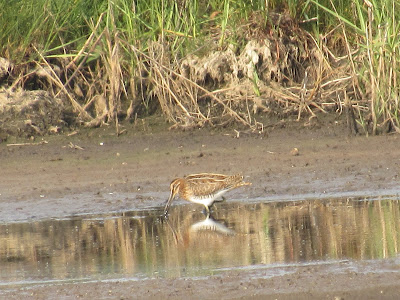
                                                   

Potential breeder - snipe

It continues: "We are keen to work closely with the local community to shape the details so we can create a space that everyone can be proud of."

Because of hitches - not least the delay caused by Covid pandemic - it has taken until now to start excavating the lagoons and various scrapes.

But once these are established, is there any reason why Sandilands should not attract the same array of species-  and in similar numbers - as the phenomenally successful RSPB reserve some 35 mile away at Frampton Marsh, south of Boston, also in Lincolnshire?

The principal contractor for the Sandilands scheme is The Casey Group which is based in Rochdale, Lancashire.

The main works to be carried out are listed as follows: 

• Earthworks to re-model existing site levels to suit the new development

• Drainage installation to service the new wetlands including weirs and culverts

• New footpaths and boardwalk installations to provide safe access around the facility

• New play equipment and bird hide installations

• Soft landscaping including new planting

• New boundary fencing and information signposts

• New car parking areas and overspill grass car park

• Retaining structures and foundations to suit the site level

The Casey Group has  given an assurance to keep disruption to nearby residents to the minimum.

It says: "The public highway at  nearby Huttoft Bank will be kept in a condition whereby it is mud-free. 

"Wheel washing facilities and spray-off areas with sump facilities will be placed within our compound and at the main entrance to prevent mud and or other materials being deposited onto the highway.

"Vehicles can also be washed down upon arrival to site to control cross-contamination.

"Road sweepers will be used throughout the project and service the whole area and surrounding road network. 

"Daily highway checks will be carried out by the site management team and photograph records kept." 

Meanwhile, measures have already been taken to eradicate New Zealand Pygmyweed - an aggressive invasive non-native species that had been flourishing on the edge of  the southernmost pond.

Says a report: "The spoil excavated to create the pond by the previous site  owner had been situated on the edge of the pond. 

"A local contractor was therefore  engaged to bulldoze the material back into the pond, thereby effectively burying the weed.

"Subsequent checks have found no evidence of the plant in nearby ditches and ponds which remain dry for most of the year." 

By contrast, the National Trust says it is keen to ensure that  Bird’s-foot Clover persists at the site

"Sandilands is the only known location in Lincolnshire of this plant which seems to favour ground newly disturbed by human or livestock footfall."

All being well, the project should be completed by spring next year, though it may take a year or two more for the reserve to be established and discovered by birds and other wildlife.

Part of the funding came from a NT supporter who specifically asked for the money to be spent in Lincolnshire. Substantial further monies came from the Neptune Coastal Campaign.

It is the first coastal acquisition the conservation charity has made in Lincolnshire, and its first coastal purchase since acquiring 1.35km of the White Cliffs of Dover back in 2012. 

Partner organisations in the ambitious venture include the  Lincolnshire Wildlife Trust, Lincolnshire County Council and East Lindsey District Council. 

Artist's impression of the proposed visitor centre - Jonathan Hendry Architects

Aerial view of the former golf course - photo: John Miller/ National Trust

Wednesday, 4 September 2024

Concerns grow for future of Common Gull - a seabird whose population is spiralling ever downwards

Common gull - numbers have plummeted

THERE is disappointing news on the fortunes of the Common Gull.

Despite its name, it was never particularly 'common' - and now it is becoming even less so.

Such has been the population decline of the species since the year, 2000, that it has now been officially re-categorised from Amber-listed to Red-listed.

According to an article in the current edition  of British Birds journal, the decrease between 2020 and 2023, when the last survey was conducted, has been  52 per cent. And the reasons for its demise are not known.

It is not the only British seabird that is faring poorly.

Also re-categorised as red-listed are Leach's Storm-petrel (down 79 per cent), Great Black-backed Gull (down 56 per cent) and Arctic Tern (down 50 per cent).

The Great Skua is also Red-listed.

On the positive side, number of European Shag, Common Tern and Black Guillemot appear to be increasing.

The first has been moved from Red to Amber, while the other two have moved from Amber to Green.


Common terns - happily their numbers seem to be increasing

Tuesday, 3 September 2024

Where have all the cuckoos, swifts and housemartins gone? Poet Pam Ayres' lament for loss of wildlife

Pam Ayres - saddened by loss of cuckoos, swifts and frogspawn


POET Pam Ayres has expressed dismay at  the loss of wildlife since she was a girl growing up in a council house at Stanford-in-the-Vale,  Oxfordshire.

Ayres (77), who now lives - with husband Dudley - in a village near Cirencester in Gloucestershire, recalls a time  when cuckoos, swifts, swallows, water voles and frogspawn were abundant.

But interviewed by feature writer Ria Higgins for the August 31 edition of The Daily Telegraph newspaper, she says: "When I was a child, I thought this would always be so, but now it’s all gone.

"It is so sad."

Since achieving success as a highly witty poet and broadcaster, Ayres has been able to afford the purchase of 22 acres of land which she is managing for wildlife.

The first things she did were to dig a pond and plant 500 trees - tasks to be followed later by planting border hedging including yew, spindle, hawthorn, bird cherry, hazel and holly.

Her next step was to put up nesting boxes for barn owls - presents from one of her sons and one of her brothers.


Red-legged partridge - a species nesting in the poet's garden

These, she says, have proved a "great success".

After a promising start, less can be said of the housemartin nest boxes she has had put up under the eaves of her house.

The first year, there were 17 pairs, but the number gradually dropped, and last year there was none.

“It’s heart-breaking, she says. "I only hope we can bring them back."

On a brighter note her garden is home to both grey and red-legged partridges, with the latter nesting.

Doggedly Onward - A Life in Poems by Pam Ayres is due to be published by Ebury Press on  October 3.


Due to be published next month


Sunday, 1 September 2024

Early signs are that Scottish rewilding project is boosting population of black grouse in The Highlands


Male black grouse - a bird with very specific habitat requirements


AN encouraging report seems to indicate that a rewilding project in the Scottish Highlands is reaping early dividends for the black grouse.

The project is a venture by rewilding organisation Affric Highlands with encouragement from RSPB Scotland, Forestry and Land Scotland (FLS) and certain landowners.   

The black grouse is a spectacular bird found across northern Europe in mosaic habitats where areas of woodland, moorland, and grassland meet.

Mature commercial forestry plantations, with their closed canopy, are  unsuitable for the species.

"Our initial findings are a cause for optimism," says Nicola Williamson, a field officer with the Affric Highlands rewilding team. 

"Restoring the health of a mosaic of habitats appears to be offering much-needed hope for the black grouse - and for nature more broadly."

Between April and May this year, 14 sites in the Beauly area of the Affric Highlands rewilding landscape were assessed by groups of trained volunteers, each studying plots covering five square kilometres.

These surveys recorded 405 lekking males -  a slight increase since the last survey in 2021, and the highest recorded over the past 17 years. 

The same survey sites have been monitored in previous years, using  the same methodology. 

In 2007, 250 lekking males were counted. 

With black grouse numbers fluctuating over time, and historic data lacking for some years, future surveys carried out as part of the study will confirm whether this overall rise is steady.

Rewilding  has involved excluding herbivores, such as deer, to reduce overgrazing and over-browsing.

This has allowed habitats to recover through the growth of healthy shrub layers and young trees. 

Simon McLaughlin, who is  RSPB site manager at the Corrimony and Glenborrodale Nature Reserves, comments: "The support from local volunteers, estates, and other organisations this year has inspired optimism that these birds will be well looked after in the coming years.

"We hope to see even more of this community involvement  as we continue collaborative efforts to safeguard this remarkable species."

Among those funding the project are  the Ecological Restoration Fund, the Dutch Postcode Lottery, WWF-Netherlands, and Arcadia.

The last UK-wide survey of black grouse was way back in 2005.

This estimated the  population to be 5,100 males - with 3,400 in Scotland, 1,500 in England, and 200 in Wales.