|
| This super headscarf reflects Her Majesty's excellent fashion sense - but are these genuine birds? If so, can anyone identify the species? |

|
| This super headscarf reflects Her Majesty's excellent fashion sense - but are these genuine birds? If so, can anyone identify the species? |
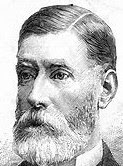
Henry Seebohm (1832-95) - steel magnate, explorer and naturalist
A dotterel is very difficult to see through a mosquito-veil, and to lie down and become the nucleus of a vast nebula of mosquitoes is so tormenting to the nerves that we soon chose to adopt the consolatory conclusion that the grapes were sour and not worth the trouble of reaching after
Or, in plain words, that the birds had not begun to breed, and it was no use martyrising ourselves to seek their nests.
The mosquitoes were simply a plague.
Our hats were covered with them. They swarmed upon our veils. They lined with a fringe the branches of the dwarf birches and willows. They covered the tundra with a mist.
I was fortunate in the arrangement of my veil, and, by dint of indiarubber boots and cavalry gauntlets, I escaped many wounds.
My companion was not so lucky.
His net was perpetually transformed into a little mosquito-cage. His leggings and knickerbockers were by no means mosquito-proof. He had twisted a handkerchief round each hand, but this proved utterly insufficient.
Had it not grown cooler on the hills, as the sun got low, he would certainly have fallen into a regular mosquito fever.
We were told that this pest of mosquitoes was nothing as yet to what it would become later.
"Wait a while," said our Job's comforter, "and you will not be able to see each other at twenty paces distance - half a dozen regiments of mosquitoes will rise between you."
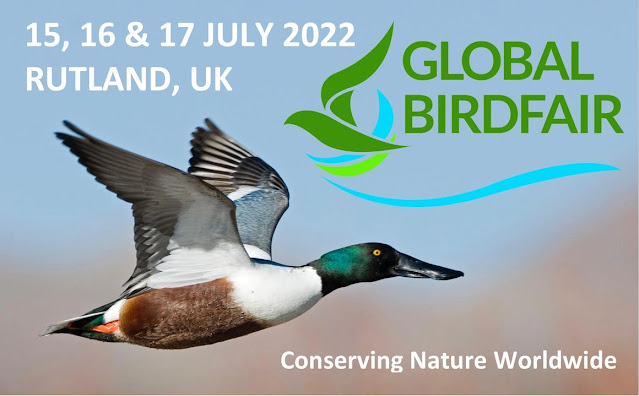 |
| Logo of the event - the shoveler is Tim Appleton's favourite bird |
CALLING all birders! Birdfair is to go ahead later this year - but under a different name and at a different location.
It was feared the long-running event was doomed when, late last year, its traditional hosts, the Leicestershire and Rutland Wildlife Trust, pulled the rug.
But co-founder Tim Appleton MBE refused to be beaten.
Just before 9am this morning, he revealed that it would be relaunched under a new name - Global Birdfair - at Rutland Showground in Oakham, close to its previous home at Rutland Water.
"I am delighted to make this announcement,"he enthused. "Birders and wildlife enthusiasts from around the world will have the opportunity to gather to make a difference to conserving Nature worldwide."
Within four hours of the announcement, more than 100 potential exhibitors had submitted inquiries about stand space
Historically, the event has been held in August, but this year the birdfair will be held over the three days Friday July 15 to Sunday July17 (9am to 5.30pm - last admission 4pm).
Another change is that Global Birdfair will be working closely with a carbon offsetting organisation to make proceedings "as carbon neutral as possible" - quite a challenge given that most exhibitors and visitors will be arriving by car.
The showground, which is owned by the Rutland Agricultural Society, comprises 150 acres (over 13 fields), an expansive car park, 39 showers and 35 WCs, plus a licensed bar.
Advance ticket purchases will be available online from February 14, and there will be cashless payment systems for ticket sales on the gate .
News of Global Birdfair will have delighted Oakham traders because, historically, the even has generated some £1.2-million annually to the local economy.
Those wishing to stay can book with the usual accommodation providers, and it is thought two local public schools - Oakham School and Uppingham School - will offer bedrooms. Some camping space will also be available at the showround
Tim Appleton hopes to announce a charity conservation project soon.
 |
| Plenty of space - Rutland Showground is just outside Oakham |

A 'VAGRANT' mute swan is making headlines in India.
Is the bird that has turned up at the Dhinchada Lake in Jamnagar, Gujarat, truly a wilding? Or is it an escape from a zoo or private waterfowl collection?
If the former, it is believed to be the first authentic record of the mute swan in India since 1911.
However, Dr R Suresh Kumar, an authority on avian migration from the Wildlife Institute Of India in Dehradun, has his doubts.
According to a report in the English-language daily newspaper, the Hindustan Times, he reckons it "does not seem plausible" for a mute swan to migrate to Gujarat because it is too far south of the species' geographic range.
It might be more feasible were the bird to have been seen at the foot of mountains in the north of the country where wild swans are occasionally driven by outbreaks of severe weather in northern latitudes.
However, many twitchers have made the trip to see the “rarest of rare wild migrants" just in case.
Says the Times reporter Vikram Jit Singh: "Wildlife photographers are currently going gung ho."
Before the provenance of the bird is determined, he says there will need to be "a behavioural assessment of its relative degree of reticence, vis-a-vis humans".
The reporter adds: " Interestingly, not a single photo or video of the Jamnagar swan in flight has been put up by the army of long lenses, though one would expect that a swan which has supposedly flown thousands of miles in migration would be testing its wings regularly."
A CHIEF operations officer is sought for the British Ornithologists' Union at a salary of £40,500.
After 25 years running the BOU, Steve Dudley is stepping down in July. |
| The saltmarsh - a dangerous place, especially after dark in winter |
A 57-year-old man is today recovering from hypothermia after becoming stranded on a saltmarsh noted for its over-wintering wading birds such as curlew, redshank and snipe.
It is not known if he is a birder, but he spent much of yesterday evening and last night stuck in mud at Cleethorpes in Lincolnshire.
In desperation, he set light to his jacket - either to keep warm or in the hope that the flames would alert a passer-by (or both).
The man, who has not been named, became stuck in mud after trying to take a 'short cut' from the resort's outer beach outer beach to the leisure centre car park.
But this is a route that is deceptively treacherous - uneven, slippery and criss-crossed by deep water-filled gullies.
Even in dry weather in summer, many are caught out and need rescuing.
Happily for this man, his cries for help were heard, shortly before 11pm, by a dog-walker who raised the alarm.
The Coastguard, the RNLI and other emergency services managed to trace the individual, but the quest took almost 90 minutes because it was dark and the shivering man had now fallen silent.
After spending the best part of 12 hours either on the beach or stuck in saltmarsh - with temperatures plummeting towards zero - he was taken to Grimsby's Diana, Princess of Wales Hospital where, it is understood, he has responded well to treatment.
The incident provided a reminder of the dangers of the saltmarsh and is likely to prompt calls for warning signage to be prominently installed.
 |
| The fringe of the saltmarsh looking over to Cleethorpes - a popular holiday resort |
 |
| Curlew - the species is conspicuous in winter |
 |
| Redshank - fairly commonly seen on the marsh |
 |
| The numerous creeks can be tricky - especially when fall of water |
 |
| Back and forth went the jet- skiers |
 |
| Would there be no relief for the panicking shorebirds? |
 |
| Time to take a stand - the oystercatchers stay put and cast their collective spell |
 |
| Oh, the shame of it! The broken down jet-ski is towed home, but still the chance for one last disturbance |
 |
| Could this be the solution? Report from The Daily Telegraph |