Saturday, 23 January 2021

SPOTLIGHT WILL FALL ON RSPB'S FRAMPTON MARSH RESERVE AT FORTHCOMING ZOOM BIRD CONFERENCE


Welcome to Frampton Marsh, near Boston, in Lincolnshire

It may not be too late to book for a place at next Saturday afternoon's virtual conference being held jointly by the BTO and the Lincolnshire Club.

Tickets for the conference, which will be held online via  Zoom, cost just £5.

The programme is follows:

15.00 Welcome – Phil Espin, LBC chairman

15.05 Black-tailed Godwits: Lincolnshire to Iceland – Jenny Gill
Anyone who has been birding in Lincolnshire  over the last few decades will have witnessed the huge increase in numbers of wintering Black-tailed Godwits. Tracking of marked individual Godwits since the 1990s has helped us to work out why numbers have gone up and why eastern England has seen some of the biggest increases. All will be revealed in this presentation.

15.35 Managing Frampton Marsh for passage and breeding waders – John Badley, Warden, RSPB Frampton Marsh
An illustrated talk on the design and ongoing management of a coastal wetland for waders through ‘dynamic management.’ The challenges, considerations and opportunities in trying to make the reserve a 'factory' for breeding waders and an ongoing 'production line' of passage waders for birders to enjoy.

16.00 Comfort break

16.10 How your birdwatching records are used in Europe – Dawn Balmer
The short talk will show how your general birdwatching records and data from the surveys birders take part in are used in projects and schemes across Europe.

16.35 Nocturnal migration: things that go 'tseep' in the night – Simon Gillings
Every spring and autumn, millions of birds migrate over us whilst we sleep. Recent years have seen considerable interest in using audio recorders to capture the flight calls of these migrants, either to boost garden lists or as part of more structured monitoring. Simon will introduce nocturnal migration, discuss how recordings can be taken and illustrate some of what he has learned about this topic. Expect to have your eyes, ears and minds opened to what could be skimming your rooftop while you slumber.

17.10 Close

The conference will be chaired by BTO's Dawn Balmer.

Places available
BOOK PLACES ONLINE


Black-tailed godwit - non-breeding birds on increase in Lincolnshire


Friday, 22 January 2021

WILDLIFE CONCERNS MAY STALL EARLY START TO AMBITIOUS THEME PARK REVAMP PROJECT


Since the demise of the theme park, Nature has bounced back at Pleasure Island

WORRIES over the threat to wildlife, including rare birds, could scupper any hopes of an early start on an ambitious scheme to transform the former Pleasure Island site in Cleethorpes, North East Lincolnshire,  into a holiday village.

The consortium behind the project had hoped to avoid the time and cost of commissioning a full environmental impact assessment.

Since the closure of the theme park, the land has 're-wilded' itself, providing a  precious home to badgers, deer, birds, bats and probably  frogs, newts and other amphibians.

Developers have suggested that mitigation could be provided, for instance, by installing nestboxes, plus some cosmetic planting.

But Natural England has indicated its unwillingness to approve any short-cut approaches to safeguarding the important ecology of the site

The organisation has warned any development could have  "significant impacts" which could spill over to the Humber Estuary  - one of the UK's most important wildlife habitats - and it is calling for an in-depth environmental assessment.

This view is shared by North East Lincolnshire Council's ecology officer Rachel Graham who has made a couple of other significant observations - the site was once used for landfill and it is ravaged by Japanese knotweed, an invasive plant that is very difficult to eradicate.

The consortium aiming to breathe new commercial life into the site is led by two property developers, both with local connections, and the supermarket chain, Lidl.

Their vision is for a complex of holiday lodges, a recreational lake, an hotel (accommodating a casino and conference facilities), a fuel-filling station,  a small-scale supermarket and various other small shops and leisure units.

NELC's planning function is controlled by Engie, itself a developer, which is understood to be strongly in favour of the project given the potential job-creation benefits.

But should Nature be sacrificed at the altar of the economic gods? It is a tricky dilemma.

The planners are perfectly at liberty to disregard the comments of both Natural England and its ecology officer, but at the risk both  of reputational damage and the integrity of the planning system.


The pond and reedbed provide important all-year habitat 


Saturday, 16 January 2021

BIRDING COUPLE'S AUSSIE HORROR AS PRECIOUS BINOCULARS AND SCOPE GO AWOL


You've got to see the funny side - wader enthusiasts Rick and Elis Simpson 

 IT is  every birder's nightmare.

After the long flight from London, via Dubai, you and your partner have arrived  in Perth, Western Australia, intent on seeing many fantastic birds.

As you lounge back in the seat waiting for your coach to set off for your hotel, you realise something is missing.

You check: Suitcase, laptop, rucksack? Rucksack! Where the heck is the rucksack?! It  contains two pairs of binoculars and a scope?

This is what happened to Rick Simpson and wife Elis back in September, 2013.

It did not take them long to twig that  they must have left their £5,000 worth of optics on another  bus - one which they could now see as it left the airport terminal on its way to who knows where. 

In panic, Rick jumped off the stationary bus and sprinted - screaming and gesticulating wildly - in pursuit of  the bus where he believed their rucksack to be languishing.

It was the first time he had run, let alone sprinted, for almost 30 years.

What is more, he has a chronically dodgy back as a result of an injury sustained during his illustrious career as a firefighter.

But his dash was to no avail. The bus gathered speed and disappeared from sight.

What happened next is recounted by the couple in their fabulously entertaining new book, A Quest for Waders.

As well being  superbly-illustrated with both photographs and line drawings, the book is a compendium of the numerous scrapes they got into as they travelled the globe (14 different countries, nine different flyways)hoping to see as many birds, specifically waders, as possible.

On one occasion, they and their vehicle had to be rescued by police after becoming hopelessly stuck on a foul-smelling sewage farm 

On another, they were woken at night by the alarming sound of elephants munching through the grass-made roof above their heads.

Many of the 'hotels' they booked on their budget adventure turned out to be in a disgusting state - with broken showers, blood-stained bedsheets or infested with bugs of all shapes and sizes. 

And there was one scary flight which, but for the brilliance of the pilot, could have ended in tragedy.

The page-turning narrative of A Quest for Waders is a vibrant blend of the magnificent (the birds) and the horrific (the practicalities of actually getting to find them).

It  is written in a fast-paced highly amusing style, peppered with abundant laughs.

If you welcome learning about the world's waders and enjoy a good chuckle, this is most definitely the book for you.

Its launch price is £15 but until the end of February only, it is available for a reduced price of £13.50 plus £3.50 UK postage.

To claim this 10 per cent discount, email Rick and Elis  at  waderquest@gmail.com and state whether you would like to pay by cheque or PayPal (bank cards option currently not available).

More details about Wader Quest, which is a registered charity, at Welcome to wader Quest - Wader Quest

Monday, 11 January 2021

ONE BOUNCER AFTER ANOTHER! BEEFY BOTHAM ALL FIRED UP IN FEUD WITH TV BIRDER CHRIS PACKHAM

Chris Packham - pictured here at the 2019 Birdfair


THE feud between ex-cricketer Ian Botham and high-profile naturalist/ broadcaster Chris Packham has bubbled up anew.

The duo have long been at loggerheads because of Packham's campaign to end driven grouse shooting - a pursuit enjoyed by Lord Botham.

Packham believes the field sport leads both to widespread environmental damage and to persecution of raptors by gamekeepers intent on safeguarding grouse chicks until they are old enough to provide quarry.

By contrast, Lord Botham believes gamekeepers deserve credit, not least  because they also seek to protect moorland birds such as curlew  and golden plover.

In a comment piece in today's Daily Telegraph, Lord Botham writes:

"Mr Packham is a very effective politician dressed up as a presenter.

"His BBC influence allows him to push his anti-countryside agenda, and he has forced farmers and gamekeepers to change how they look after nature.

"His power comes not from being elected but largely from his BBC role. This is wrong."

As of 5pm today, the broadcaster had not responded.


Salvo - Lord Botham's article in The Daily Telegraph


NEW CONCERNS THAT BIRDS ON HUMBER ESTUARY COULD FALL VICTIM TO AVIAN FLU


Vulnerable - knot feeding on Cleethorpes Beach


FEARS have been voiced that thousands of  birds in the Humber Estuary could succumb to a deadly strain of avian flu.

It follows reports that more than 1,000 knot - a wading bird species familiar on Grimsby and Cleethorpes mudflats - have been found dead or dying in Schleswig-Holstein Wadden Sea over the past few days.

Bird flu used to be blamed on infected starlings flying to the UK from Russia and Siberia during autumn and winter.

However, latest scientific thinking is that the disease is a by-product of the global poultry-industry.

In the UK, cases seem mostly to have occurred in the West Country, particularly on the Severn Estuary where many mute swans have lost their lives.

To date, East Coast estuary birds seem to have been spared, but, at this time of year, many - waders, waterfowl and gulls - regularly cross back and forth across the North Sea, especially in hard weather.

At Spurn Bird Observatory, a spokesperson comments: "There is the real chance that birds on the Humber may become infected."

Anyone seeing sick gulls, waders or wildfowl can contact a special Defra hotline:  03459 33 55 77 - option 7


Hard hits - swans on the River Severn


LAND AT DEPARTING GRIMSBY INDUSTRIAL GIANT EARMARKED FOR NEW WETLAND BIRD RESERVE


The Novartis site sits on the edge of the Humber Estuary 

A NEW 35-acre wetland bird reserve is set to be created on the South Bank of the Humber.

It will be developed on land around the site of the 220-acre Novartis chemical works, on the outskirts of Grimsby, when the multinational pharmaceutical company bids farewell at the end of this year.

To be known as Novartis Ings, it will be a sister site to the Cress Marsh project in nearby Stallingborough.

This new reserve will benefit from being adjacent to the Pyewipe mudflats - one of the UK’s most important sites for feeding and roosting waders of numerous species including curlew, golden plover, lapwing, dunlin, redshank and avocet.

Like Cress Marsh, it will be a “mitigation site” provided to compensate for wildlife habitat likely to be lost to make way for future industrial development nearby.

Unfortunately, because of shortage of staffing and management resources, Novartis Ings  is unlikely to be open to the public in the same way as, say, the RSPB reserves at Frampton and Freiston, both near Boston, but bird-monitoring and recording will be undertaken by specialists.

It is understood that the reserve will be managed by North East Lincolnshire Council.

The site covers some 220 acres in total


As this sign indicates, Novartis is already mindful of its responsibilities to wildlife


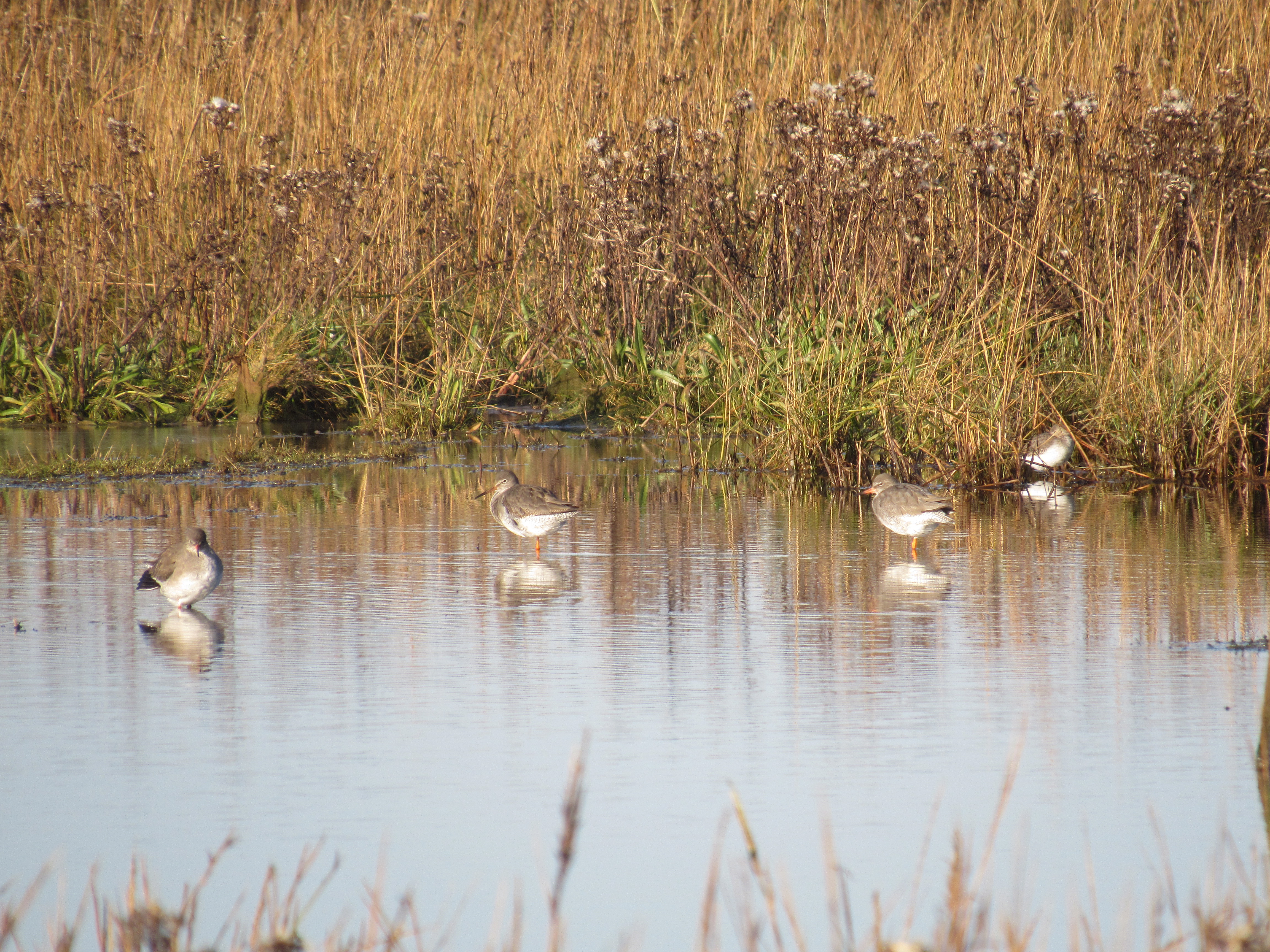
Redshank - one of many wading bird species set to benefit

Saturday, 9 January 2021

BECKHAMS WIN CONSENT FOR ISLAND PROJECT - SO LONG AS THEY GIVE NATURE A SPORTING CHANCE


All that's missing is the binoculars - the Beckhams have a taste for country life (photo: Instagram) 

A-LIST celebrity couple David and Victoria Beckham have been granted consent to create an island within the lake they are currently having excavated in the gardens of their home near Chipping Norton in Oxfordshire.

But council planners imposed various conditions including a stipulation that "the scheme shall include, but not necessarily be limited to, the following biodiversity enhancements" either on the site or nearby:

* The creation of a native vegetation on the margins of the water

* The planting and infilling of hedgerows, using native species

* The retention and enhancement of a wildflower meadow

* The creation of bunds, planted with native shrubs and trees

* A five-year maintenance plan

A further condition is that, to safeguards birds and other wildlife from disturbance,  the island should only be accessed by rowing boat or some other non-motorised means.

The couple have other homes in London and elsewhere, but they have spent an increasing amount of time at their rural retreat in Oxfordshire during lockdown.