Thursday, 16 July 2020

BYGONE BIRDING: SCOPS OWL WAS SUSPENDED ON SPINY TWIG BY ITS EYELIDS

Collared scops owl
                                          

A few days ago whilst birds-nesting in a ravine near Dehra Dun (at the foothills of the Himalays in northern India), I disturbed a Scops Owl.

It was sitting in a small tree over which the prickly climber, Caesalpinia scpiaria, was spreading. 

In its flight, the owl accidentally collided with one of the dry, curved, leafless branchlets of the creeper which is armed with short curved spines, mostly in pairs. 

To my surprise, the owl remained fluttering and suspended from the spiny twig from which I had considerable trouble in extricating it. 

It had been caught by the eyelids by at least two thorns both above and below the eye - and so securely that I think it improbable that it would have managed to effect its escape unaided. 

The bird proved to be the Collared Scops Owl.

I kept it a few days in captivity, feeding it on cockroaches, and then
allowed it to escape.

B. B. Osmaston
Dehra Dun
August, 1916

* Photo: Jack Walf via Wikimedia Commons

Wednesday, 15 July 2020

WHO PULLED THE TRIGGER ON MUCH-LOVED BIRDFAIR FOUNDER - OR DID HE SIMPLY SELF-DESTRUCT?

Tim Appleton - services no longer required

MYSTERY continues to surround the shock departure from Birdfair of its much-respected founder and manager, Tim Appleton MBE.

Over his past years 31 years' supervision of the famous Rutland Water event, Mr Appleton has become to birders what the late Patrick Moore was to astronomers - a legend.

Probably his last announcement as Birdfair chief was a reluctant one - on April 7, he said the plug would have to be pulled on this year’s event in the wake of the coronavirus pandemic.

But within a space of less than two months, the plug had also been pulled on him - or at least on his role as manager of the globally-famous event.

His involvement was at an end.

The shock revelation came not through any formal announcement - more of a leak in an interview he gave to broadcaster-naturalist David Lindo, the self-styled Urban Birder, on May 31.

                                           
Interviewer David Lindo - currently in Spain 

He said he was "pretty gutted" to be shown the exit door but, for reasons that he declined to divulge, it had become "impossible" for him to continue.

Since then, Mr Appleton has made no further public comment.

Nor have his erstwhile employers, the umbrella body for Birdfair - the Leicestershire and Rutland Wildlife Trust.

In the resulting information vacuum, rumours have inevitably flown thick and fast - around the world and back again.

Was there a row over Mr Appleton's salary? Was his management style deemed too laid-back for these more corporate times? Was he devoting insufficient time to the job in favour of other pursuits? Had he allowed aspects of Birdfair to fall prey to the politicking of pressure groups such as Wild Justice, run by his friends, broadcaster Chris Packham and campaigning blogger Mark Avery?

Had there been a personality clash with the Trust’s recently appointed chief executive, Tim Graham, or its clarinet-playing chairman, Andrew Cotton. Or was it felt he was now past his prime and a fresh face (or faces) would benefit Birdfair in these youth-at-all-cost times?

Quite likely all these rumours are well wide of the mark, but, pending clarification either from Mr Appleton or the Trust, speculation will remain rife.

Normally, in these sorts of situations (think sacked football club managers), a statement mutually agreeable to both parties is agreed, then released.
                                   
Northern shoveler - Mr Appleton's favourite bird

But as of start-of-play today nothing had been published on the websites either of Birdfair or of the Trust.

Nor has Mr Appleton taken to social media.

In a bizarre twist, the history of Birdfar has been removed, at least temporarily, from its website while it is being rewritten - is this in order to downplay its founder's vital involvement?

Most extraordinary of all, not a word of thanks to Mr Appleton has been expressed publicly either by  the Trust corporately or, individually, by  any of its board of management.

What next? The Birdfair team has stated its intention to stage a 'virtual' Birdfair next month, but, given the importance of social interaction to the success of previous fairs, might this be a mistake?

In the meantime, Mr Appleton is working on at least one other major project but is keeping it under wraps until later in the year.

As he teasingly told David Lindo: "Mum's the word."

What might that project be? After 30 years at the helm of Birdfair, its founder's contacts book is bulging and his organisational expertise is second to none.

Could it just be that, come 2021, Birdfair will have a competitor event?

Time will tell.

David Lindo's interview with Tim Appleton can be viewed at:

Below - flashback to last year's Birdfair

The queue lengthens just before the start of play on the opening day
             
The weather (and conditions) could have been kinder, but that didn't detract from a brilliant Birdfair - held, as always, at Rutland Water. Above and below are some of those (including the great and the good) who attended.

Come on, it's 9 o'clock - let us in!

Yes, glad to be here - things are looking promising
                               

The RSPB's chief executive, Mike Clarke, was among the punters

THE BTO's chief executive, Andy Clements, enjoys a chuckle

Also at the BTO stand was its new chairman, BBC-TV reporter Frank Gardner


The organisers think of everything - including allocating  a designated area for smokers

Crowds everywhere - but this fellow found a tranquil spot to enjoy a few moments'  reflective solitude


Birdfair reports you may have missed:

* Iolo Williams: https://bit.ly/2WlnGmi

* Georgina Locock: https://bit.ly/2WglOLR


* Lucy McRobert: https://bit.ly/3ewVZ06

* Mark Cocker: https://bit.ly/2OqQdCP

*  Ruth Tingay:  https://bit.ly/32ixnWv

* A squelchy bogland: https://bit.ly/2CGiliv


Monday, 13 July 2020

DECISION-DAY LOOMS ON APPOINTMENT OF NEW SUPREMO FOR LEADING UK BIRDING GROUP

                                                       
BTO chief Andy Clements - tough act to follow

A DECISION is expected to be made this week on who will take over the reins at a leading UK bird-recording organisation, the BTO.

The Norfolk-based group is keen to appoint a new chief executive to succeed Dr Andy Clements who is stepping down later this year.

The closing date for applications was June 5, with those shortlisted interviewed by video-conference last Wednesday.

It is understood that second interviews were being held, in person, earlier today at the BTO's offices at Thetford.

Whoever lands the job can look forward to a salary of between £75,000 and £85,000, depending on experience.

Below is the job description for the post:
Are you inspired by birds and nature and passionate about science?

The British Trust for Ornithology (BTO) is seeking a new CEO to lead this vibrant organisation, champion its values and deliver its vision of ‘a world inspired by birds and informed by science’.
Full time (37 hours) permanent post, based in Thetford in Norfolk with the flexibility to work at home or from the David Attenborough Building in Cambridge occasionally.  

Benefits include: 11 per cent employer pension contribution, 25 days annual leave plus bank holidays on joining, flexible working, life assurance scheme and discounts on books and social events.

To be considered for the shortlist, candidates were expected to answer, in writing, the following questions:

1. The BTO is reaching the end of the 2015-2020 strategy period. How would you approach the next strategy period? 500 words.

2. Think about a time when you were involved in the introduction of a new system or process. How did you bring people together to make it successful and resolve issues? 300 words.

3. Imagine you are talking to a potential donor. How would you explain the role of BTO? 200 words.

It is understood the chair of the BTO's board, Prof Jenny Gill, has been overseeing the interview process.

WHAT MAKES THEM DO IT? THE MYSTERIOUS 'STORM' MIGRATIONS OF EASTERN EUROPEAN JAYS


Despite being weak flyers, jays are capable of travelling long distances (picture: Ann Williams)

Jays are mostly regarded as sedentary rather than migratory birds, but, in some years,  there can be large irruptions - flocks arriving here in the UK from eastern Europe for no conspicuously obvious reason. In this paper, published in the January, 1883, edition of The Ibis journal, Lincolnshire ornithologist John Cordeaux explores the Jay-migration phenomenon with special reference to the records of his friend, Heinrich Gätke, who, for many years, monitored bird passage as witnessed on the  island of Heligoland off the German coast.


SEEN in the depth of our woodlands furtively flitting from tree to tree, the flight of the Jay appears both laborious and heavy, kept up by frequent flappings of wing, undulating, too, and somewhat uncertain in direction and seldom prolonged beyond the nearest tree, hedgerow, or copse.

Under such circumstances, the bird seems little capable of crossing any width of sea or of taking a long migratory flight. 

The fact, however, remains beyond dispute that this seemingly weak and slow-flying bird is capable of long-sustained flights which will compare even with those of the swift-winged Woodcock and Grey Plover.

Great numbers of Jays, along with other migrants, crossed Heligoland with an east to west flight in October, 1876.

Heinrich 
Gätke's notes sent to me at that time are as follows:  "Oct. 21. East, very strong. Jays, thousands passing the island; some landed, caught; coming, never ending. 

"Oct. 22-23. East, strong. Jays, a great many still."

Since that date, and up to this year, Jays do not appear to have been observed at Heligoland.

Mr Gätke's subsequent, and almost continuous, notes make no mention of them.

Either the migration has passed some distance off the island or been carried on at such a height as to be beyond the ken of human vision.

But during the past autumn, Jays have again passed Heligoland in enormous numbers. 
                                       
John Cordeaux - farm manager and ornithologist who lived on the outskirts of Grimsby

On October 8, Mr Gätke writes: "A perfect storm of Jays has passed over, and on both sides of the island, during the last three days. 

"No one living has ever seen the like here. 

"About fifty years ago, enormous numbers were caught here, but during my time only twice or thrice have they come."

It is noticeable that, in both these years, the migration of the Jay was in October, and continued over three days, and that it was carried on under the circumstances of a strong easterly gale.

The question then naturally arises, to whence and whither was this great "storm" of Jays (as Mr 
Gätke terms it) steering their course? 

Seen then seventy miles from land off the mouth of the Elbe, moving from east to west in a strong easterly gale, continuous flock after flock, never deviating from their course which was straightforward, seemingly across the wide tossing waters of the North Sea, with one purpose animating all alike, the forsaking of their native forests for a long flight to the west.

Mr. Gatke has always maintained that autumn migration, as observed at Heligoland, does not run north and south, but from east to west, birds invariably coming from the eastward and passing westward.

The observations taken during late years on the migration of birds, as observed at lighthouses and light vessels, quite confirm the views of the veteran observer.

It is rarely that we find birds coming to our shores from any point north of east.

Migration is from east to west, or points south of east to north-easterly points.

This great passage of Jays across Heligoland points also to the correctness of his theory, for it could hardly have its origin in the north, the whole of Scandinavia failing to supply the stream for more than a few hours.

It is reasonable, therefore, to suppose that they came from Eastern Europe across Germany, from the immense forest area between the Oder to beyond the Vistula, and probably much further east than this to the confines of Eastern Europe. 

That the area covered by this flight was very great we may well judge from the fact that the stream was three days in passing.

Whether the first impulse to move began at the extreme east or west of the range, extending backward or forward, we have unfortunately no means of knowing.

It will be interesting to learn if any great flight of  Jays, corresponding in any degree with the thousands that crossed Heligoland, have been observed anywhere  on the English coast, or any considerable increase in the ordinary number frequenting our woodlands.

Previous to receiving Mr 
Gätke's letter, I had made a note of the number seen in some small plantations, but certainly not exceeding double what we might expect to see under any circumstances.

In his Birds of Norfolk, Mr. H. Stevenson conjectures that the Norfolk Jays receive at times considerable accessions to their number in the autumn. 

So far as I am aware, there is no direct evidence of the fact except the statement, as given by Messrs. R. Sheppard and W. Whitear (A Catalogue of Norfolk and Suffolk Birds, 1826) to the effect that "some years ago, as two gentlemen were sporting at Tunstall in Suffolk, a distance of about five miles from the sea, they observed an extraordinary flight of Jays passing in a single line from seaward to the interior. 

"This line extended further than the eye could reach, and must have consisted of some thousands."

"Several of them were killed as they passed, but the firing at them did not occasion the rest to deviate from their line of flight."

It may be that the Jays seen crossing Heligoland passed southward along the European coastline, as we know is the case with many birds which regularly cross that island in large numbers, and which rarely turn up on our own coast, except perhaps as solitary examples.

Be this as it may, however, this migration in such enormous numbers is a wonderful and striking phenomenon, and supplies cause for much conjecture - conjecture as to the how and why of this simultaneous movement.

Whether a mere normal phenomenon, which, under certain conditions of wind and weather, is at long intervals brought within the notice of the Heligolanders, or a something out of the ordinary range of migration due to a scarcity of food or some other cause which long patient waiting and extended observation alone can determine.


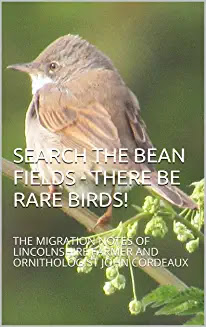
* Interested in the writings of John Cordeaux? The title below is now available (price £2) as an e-book.


Sunday, 12 July 2020

DID HE JUMP OR WAS HE PUSHED? FOUNDER TIM APPLETON 'GUTTED' AT BIRDFAIR DEPARTURE

                                           
Tim Appleton - new projects beckon

A SHAKE-UP at Birdfair has led to the ousting of its popular founder-manager, Tim Appleton, MBE.

Mr Appleton has been at the helm since he launched the event - then known as the British Birdwatching Fair - at Rutland Water, near Stamford, in 1989.

No reasons have been given for the parting of the ways, but it is understood there were behind-the-scenes disagreements with the Leicestershire and Rutland Wildlife Trust which hosts the fair.

A Trust management decision was then taken that he should be involved no longer at top level.

In recent years, there have been various criticisms about the event - for instance that it has become over-commercialised or that agitators, such as Chris Packham's Wild Justice organisation, have hijacked some of the proceedings for propaganda and fundraising purposes.

Mr Appleton is said to have been "gutted" to have been shown the door but felt proposed new arrangements - including a reduced, if any, role for him - made it "impossible" for him to continue.

His Birdfair email account has been closed, and the website has had its History section removed while it is being re-written.

No successor has been named, and it is understood future responsibilities will be shared by the Leicestershire and Rutland Wildlife Trust's “Birdfair Team”.

This year's event has been cancelled in the wake of the. coronavirus situation, but it is understood organisers are planning a virtual event for August 18-23.

Mr Appleton, a world authority on wildfowl, has every reason to be proud of what has happened since he set up Birdfair.

Not only has it become the highspot of many bird enthusiasts' social calendar, it has inspired similar smaller-scale events all over the world.

What is more, it has raised some £5-million for a range of some 30 habitat-protection and other eco-friendly initiatives all over the world.

In the wake of his departure, the former supremo has no plans to take things easy or to refocus all his energies on his long held ambition to see every known species of goose and duck  in the world.

He has other global projects up his sleeve - at least one of which could be a headline-maker.

What might they be? For the time being he is staying tight-lipped, but he hopes to make an announcement later this year.


Wednesday, 8 July 2020

THE DARK DAYS WHEN LITTLE EGRETS WERE FARMED IN INDIA FOR THEIR SNOWY-WHITE FEATHERS

                                                 
Some egret-farmers stitched up the birds' eyes to prevent them from escaping


The past couple of decades has seen an explosion in the population of little egrets. These elegant wading birds are now found across a wide variety of habitats in many parts of the UK. Intriguingly, time was when they were farmed - not here but in India - for their beautiful snowy-white feathers. These  were greatly in demand in London, Paris and other European cities and towns for the purpose of adorning the hats of 'fashionable'  ladies. Below is a report by diplomat George Birch (born June 30, 1880), written in 1914, that was published in Vol XXVI of the Journal of the Bombay Natural History Society.


FISHERFOLK of the inland waters of the province of Sind  are building up a lucrative trade in feathers plucked from the plumage of little egrets.

This  operation is conducted without injuring the birds - in the same way as feathers are plucked from the ostrich.

During the course of residence on duty at the village of Ber in the Kamber Taluka of the Larkana District, I spent  considerable time in investigating personally the modus operandi of the breeders.

I have thought it worthwhile to record the results of these investigations as the egret, or white heron, is regarded popularly as requiring most protection by the state against the depredations of man in pursuit of the beautiful  plumes, now so valuable a commodity in the world of fashion.

The village of Ber is situated on the edge of the Change Lake  in the Larkana District.

At a distance of about 300 yards from the village and practically on the edge of the water, a colony of inhabitants numbering some 200 men, women and children have their abode in reed huts. 

A feature which attracted my attention since my last visit to the village was the recent erection in front of each abode of quadrangular structures of reed mats - measuring 20ft x 8ft x 8ft - resembling a typical poultry run. 

On obtaining entrance into one of these structures, I found it contained at least three score pairs of full grown egrets in a state of freedom,

There was a plentiful supply of perches for the birds, and the cage was tolerably clean. 

The birds appeared to associate in pairs, and met the intrusion with their usual hoarse cries. 

A liberal supply of food, consisting of small fresh water fish, lay about in shallow earthern platters, and the birds helped themselves  at leisure. 

The birds were fairly tame and allowed themselves to be seized by their owners without showing any fear.

There were about 20 such cages, each containing about fifty birds on average.

There was ample evidence to indicate that the birds breed freely in these conditions of modified captivity.

 Enquiries showed that, under these conditions, birds assume their nuptial plumage four times a year - twice in summer and twice in winter.

The summer plumage is comparatively poor, nearly half that of the winter plumage.

The breeding season commences early in March and continues up to the end of September. 

As soon as the breeding season begins the birds break up into couples.

Twigs are strewn about the cage, and each pair of birds build a nest. 

The birds hatch their own eggs which are jealously guarded, the male bird invariably taking the place of the mother bird when she leaves the nest for food or exercise.

The young are permitted to remain with the parent birds for about a week when they are removed and reared by hand.

The pair, meanwhile, commences to breed again.

The number of times the birds breed during this period depends on the degree of vitality of each pair.

Eggs are laid never less than twice during the season and sometimes as many as four or five times; the number of eggs each time varies from three to five. It takes about 12 months for a bird to reach maturity.

The plumes are made up into small brushes and are taken to Sukkur and Karachi for sale. 

Egret-farming has become a lucrative activity..

 The Sukkur merchants export the feathers to Calcutta whence they are no doubt smuggled out of the country to the European markets where prices ranging as high as £ 15 per  ounce of feathers are realised.

Not only has a trade in the plumes been built up, but the birds them
selves now command a high market value 

The ease with which the egrets are bred and multiply, the fruitful crop of plumes yielded by the bird and the high prices which the birds command are causing the industry to spread very rapidly in the neighbourhood of the inland waters of the province of Sind.

It may be predicted that in a few years, if the demand for the plumes continues, every fishing village in the interior of the country will have its egret farm. 

Of course the trade in plumes of the birds of the egret and heron species has always existed in Sind but the methods formerly followed were quite different and the trade never attained such large dimensions. 

The practice followed till about three decades ago, was to snare the birds and destroy them for their plumage. 

On this being stopped, by executive orders of the then Commissioner in Sind Mr. (now Sir) Evan James, the practice of snaring the birds and keeping them in captivity was resorted to.

However, this led to the infamous custom of stitching up the birds' eyes with the object of preventing them from escaping. 

The latter practice is now rigorously suppressed by action under the Prevention of Cruelty to Animals Act, and these orders have proved an important factor in the inception of the system of egret farming described in this note.

Arrangements are being made to obtain a pair of the birds for the
Karachi Zoo.

In this connection, a question bound to arise sooner or later is the
necessity for the modification of the drastic Notification issued by the Government of India in 1902 which "prohibits the taking by sea or by land out of British India of skins and feathers of all birds other than domestic birds, except (a) feathers of ostriches and (b) skins and feathers exported bona fide as specimens illustrative of natural history."

The result of the Notification has been to create a large industry in the smuggling out of the country - even in cases where destruction and cruelty to the birds concerned are not involved - of feathers that have a distinct commercial value.

If bird-farming on humane lines for the sake of plumage is to be encouraged in India, these orders must be modified. 

Only the other day the Customs authorities at Karachi seized several boxes of peacock feathers which were being surreptitiously exported under a false declaration by a European firm. 

These were confiscated and a fine imposed. 

Now it is well known that the peacock moults its train. 

The bird is regarded as sacred by a large majority of Indians and is seldom or never killed by them.

Those occasions on which it is shot by inexperienced European sportsmen have not infrequently led to collisions with the country people. 

In many other directions the necessity for the amendment
of the orders in question could be indicated, so as to encourage instead of deterring the farming of birds whose plumage has a distinct marketable value.


George Birch (Assistant Commissioner in Sind)
Karachi 
March, 1914. 


Sunday, 5 July 2020

POLICE PROBE TRAGEDY AT LINCOLNSHIRE RESERVOIR POPULAR WITH BIRDING ENTHUSIASTS


The huge reservoir at Covenham - scene of the tragedy
 

POLICE have today been continuing their inquiries into a weekend tragedy at a Lincolnshire reservoir popular with birders.

The body of a woman is understood to have been recovered from Covenham Reservoir, between Cleethorpes and Louth, yesterday  morning.

She is thought to have been in her 70s.

It is not known how long she had been in the water.

The reservoir is one of many within the portfolio of Anglian Water whose bosses are being kept  updated.

                                                              
Only last week, Anglian Water and police urged thrill-seeking  teenagers not to use this 'pier' for diving into the icy water


The message is spelled out in this warning notice